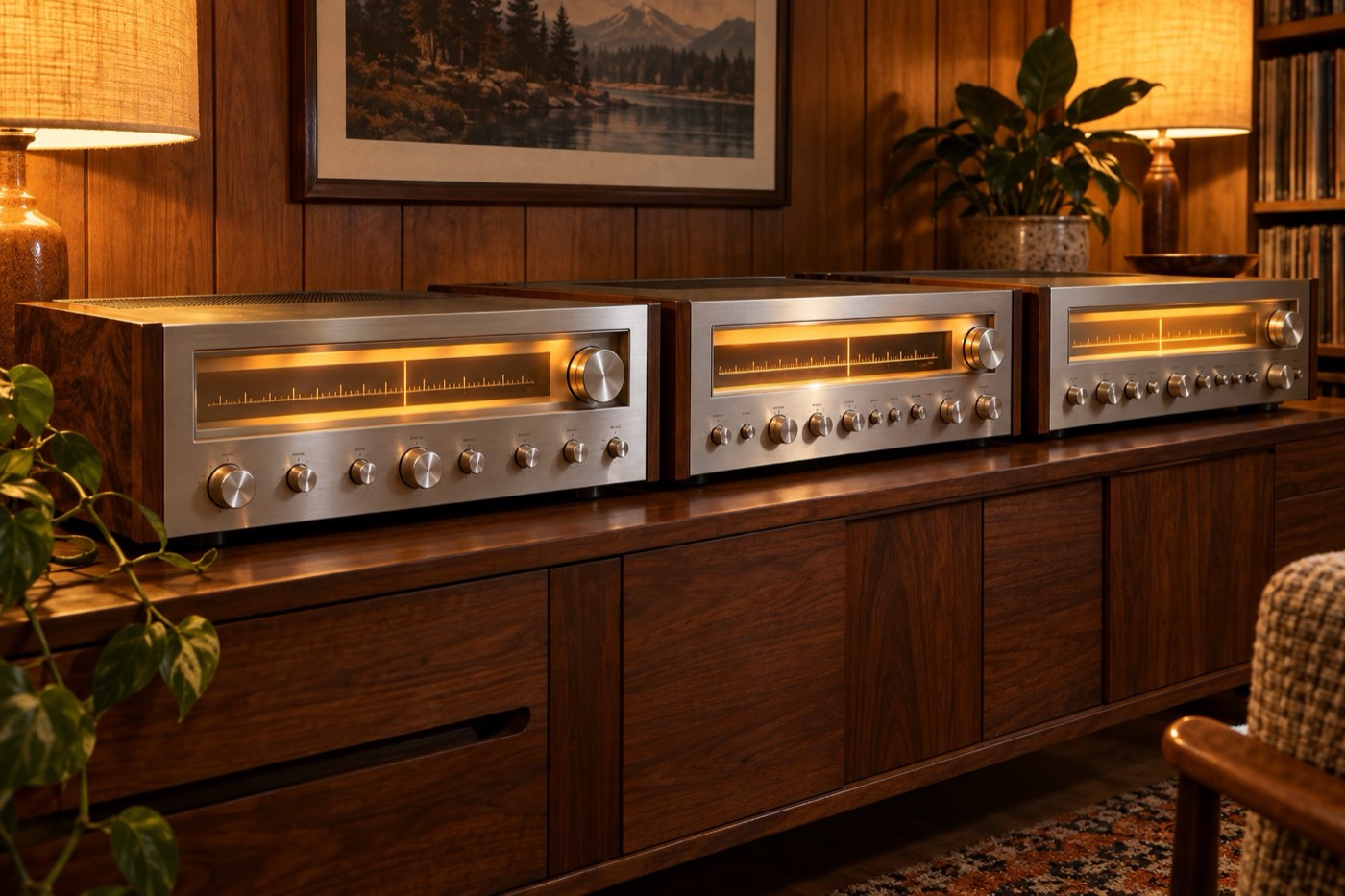
Serviced, a fifty-year-old receiver is a fine machine. Unserviced, it's a project. The book shows you how to tell.
The stereo handbook
Thirty years behind a studio desk. I know what the music is supposed to sound like. This book shows you how to test any stereo with a song you already love, which old gear is worth saving, who owns the famous names now, and how to buy the next piece only once.
Instant download30-day money backSecure checkout
How it works
Nothing ships. Nothing to install.
The arithmetic
Double the watts and you get one small step in loudness, about three decibels. That's the jump from a 50-watt amplifier to a 100-watt one, and it's the jump that costs real money in the shop.
Here's the other column. On one well-known maker's own site in September 2026, an eight-foot pair of speaker cables was listed at $1,995. Pulling your speakers a foot out from the wall and aiming them at your chair costs nothing, and to my ears it does more.
| An eight-foot pair of speaker cables (one maker's own price, September 2026) | $1,995 |
| A new stereo receiver from a long-standing maker (its own price, September 2026) | $1,200 |
| A small amplifier with its power supply (maker's own price, September 2026) | $89.99 |
| Moving your speakers a foot off the wall | $0 |
| This book | $19.99 |
Buy the wrong box and it costs you the whole box. The book costs $19.99, and it gives you the four-minute test to run before you pay for anything.
Look inside
Exactly what opens on your phone. And the download has a large-print edition too, for easier reading.
← swipe to see more pages →
What is inside
Serviced, a fifty-year-old receiver is a fine machine. Unserviced, it's a project. The book shows you how to tell.
Get your copy
One payment. No subscription, no upsell, nothing else to buy.

Instant download30-day money backSecure checkout
Buying it for a parent? Check out with your own email, then forward them the email with the download link. The large-print edition is in it.
Questions before you buy? Write to Mick

Who is telling you this
Thirty years behind a studio desk. I know what the music is supposed to sound like. That's the whole introduction, and it's all you need from me.
I'm not a repairman and I'm not a salesman. What I know is what a recording really has in it: the breath before the note, the room around the drums, a bass note that stops when it should. And I know how to tell, in about four minutes, whether a stereo is letting that through.
The book doesn't lean on who I am. It leans on two things you can check. One is your own ears, with a test I'll teach you in the first chapter. The other is the record: makers' own pages, government notices, company filings and the original magazines, each checked in September 2026. When I tell you how something sounds, I say "to my ears", so you can tell opinion from fact.
Mick
Two things to know before you buy
There's not one used or collector price in this book. Those change by the month, and a book can't keep up. What's in it are the list prices when the gear was new, with the year, the makers' own prices today with the month I checked, and the five-minute way to look up what a used one sold for last week.
Every brand, model, year, price and owner was checked against its source in September 2026, and the back of the book says where each chapter's facts came from. Where two good sources disagree, I say so. Where I couldn't confirm a thing, I left it out, so a few well-known makers and models are missing. And I take no side between records, CDs and streaming. If it makes you tap your foot, it's working.
Ask within 30 days and you get your $19.99 back. Just reply to the email your book came in.
Questions
Anyone who owns a real stereo or wants one again, and anyone who just found a heavy silver receiver in a parent's attic. It's in plain English. Every trade word is explained the first time it appears.
The whole system: how to listen, what watts mean, the great receivers of the 1970s, the stereo in your attic, speakers, who owns the famous names now, small cheap amplifiers, record players, CDs and streaming, putting a system together, setting up the room, buying used and finding a repair technician.
No. You need one song you know by heart. The five things the book teaches you to listen for are a piano's low notes, a singer's breath, a bass note, a cymbal and where the singer stands. None of them needs young ears.
No. There are no used or collector values in it. It tells you what your stereo is, whether it's worth keeping and servicing, and how to look up what ones like it have sold for.
It tells you who owns each well-known name today, with the date, and what a few companies have said on the record about their own products. It doesn't call any brand good or bad. It gives you a test to judge the box in front of you.
No. It shows you what to check with the lid on, the safe care you can do yourself on a record player, and how to find and talk to a technician. Anything that plugs into the wall and needs opening goes to a technician.
All three get a fair hearing. The book takes no side. It shows you how to get the best from each.
Every model, year, price, owner and company statement was checked in September 2026 against a maker's own page, a government notice, a company filing, the trade press or the original magazine. The receiver prices in the tables were read from the magazine and catalog pages themselves. The back of the book lists the sources chapter by chapter.
Not ready to buy?
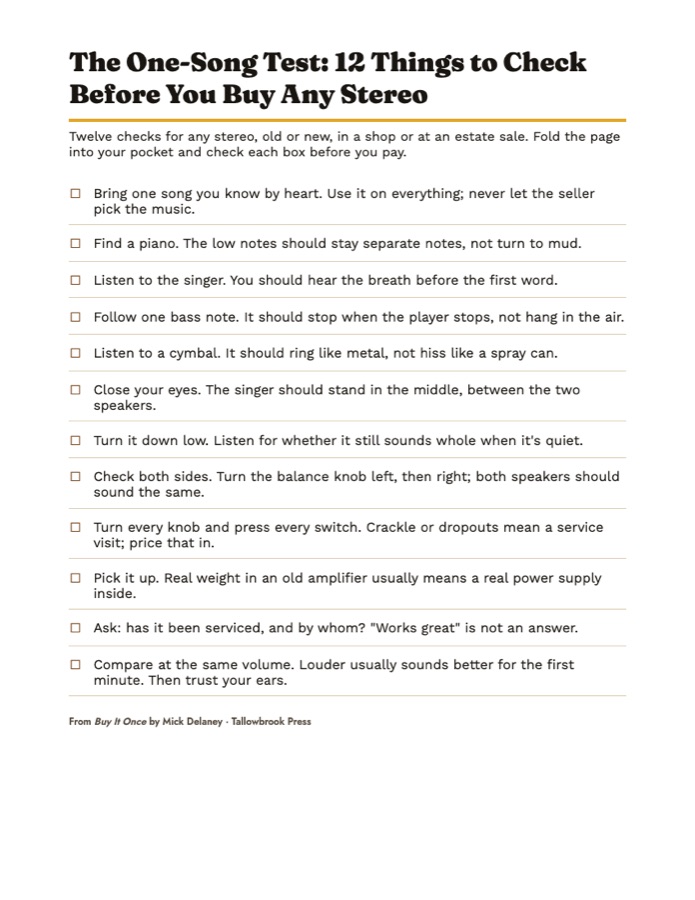
Not ready for the whole book? Take the checklist. It's one printable page: twelve things to check before you buy any stereo, starting with the song you bring and ending with the volume knob.
Tell me where to send it and it's yours. Fold it into your pocket and take it to the shop.
Ready when you are
One payment. No subscription, no upsell, nothing else to buy.
Instant download30-day money backSecure checkout